
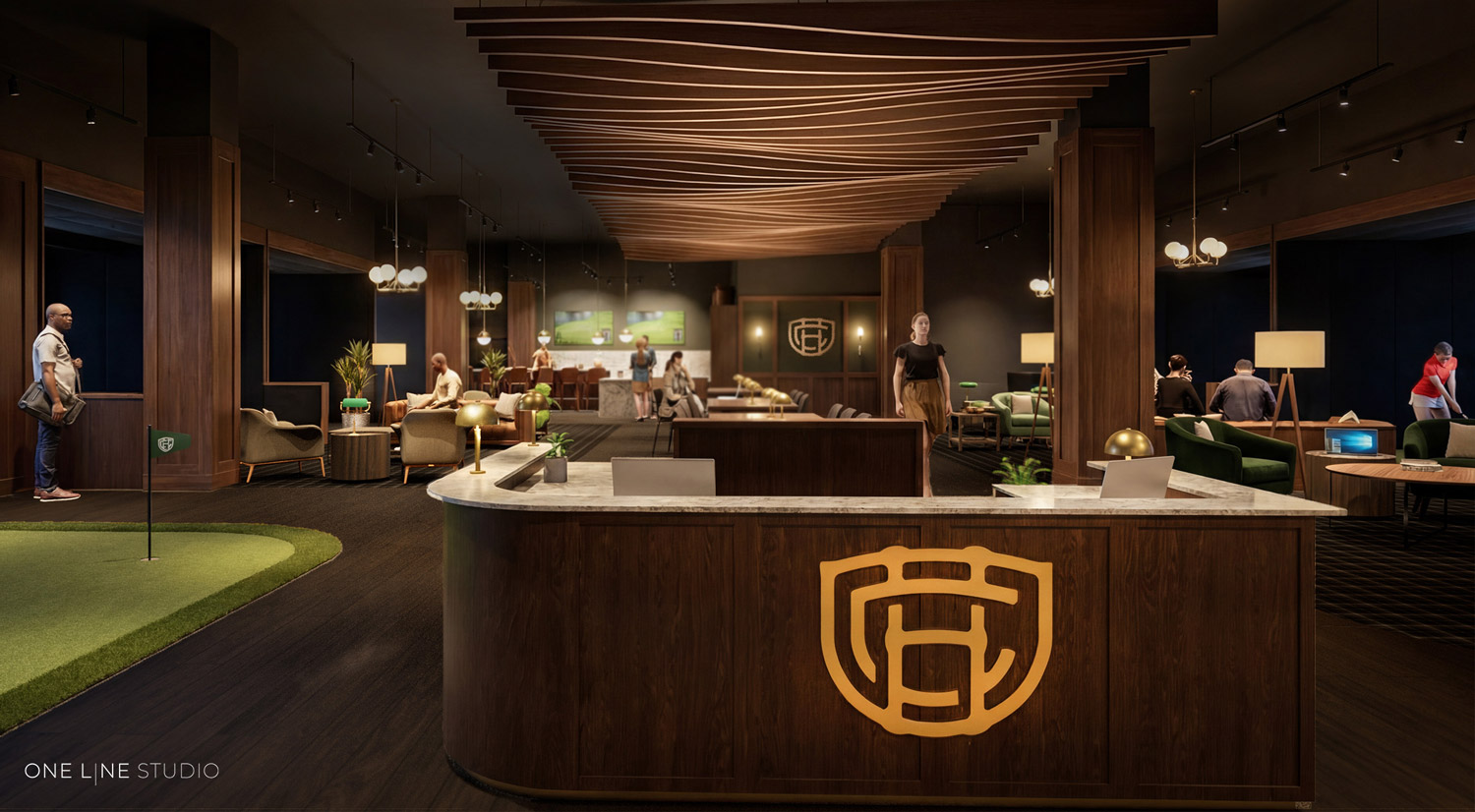
When we opened Clubhouse Work & Golf in Greenwood Village, we had a thesis: that a great place to work and a great place to play don’t have to be two separate destinations. We believed that if you put both under one roof, something interesting would happen.
We just didn’t anticipate how interesting.
A year in, the community we’ve built has taught us more about what professionals actually need from a workspace than any market research could have. And those lessons are baked directly into everything we’re building at Cherry Creek.
Here’s what we learned.
The solo desk was never really the point.
We assumed the majority of our members would be solo remote workers. The laptop-and-headphones crowd who needed a change of scenery from their home office. And yes, those members found us and love us.
But something we didn’t fully anticipate: the teams.
Modern companies don’t run on full-time offices anymore. They run on flex. Not everyone needs a desk five days a week. Not everyone needs a dedicated room. But teams do need a place where they can pull people together when it counts: a project push, a strategy session, a new hire’s first week. They need to flex people in and out without paying for space they’re not using.

Greenwood Village taught us that the best thing we could offer a growing company isn’t a row of private offices. It’s a lounge environment that actually works for groups, where two people can have a focused conversation in one corner while three more collaborate at a big table across the room, and the whole thing feels intentional rather than improvised.
Cherry Creek’s work lounges are being designed around this reality. More flexible configurations. More room for teams to spread out, not just individuals to hunker down.
Natural light isn’t a nice-to-have. It’s a performance variable.

A study from Northwestern Medicine and the University of Illinois, published in the Journal of Clinical Sleep Medicine, found that office workers with access to natural light slept an average of 46 minutes more per night than colleagues without it. They also reported better mood, more physical activity, and higher overall quality of life. Workers without windows, meanwhile, scored lower on virtually every wellbeing measure the researchers tracked.
We knew this. But knowing it and building around it are different things. At Cherry Creek, natural light is a design constraint, not an afterthought. More windows. Better orientation. Spaces that feel connected to the outside world even when you’re deep in a work session.
People wanted rooms. Just not the rooms they expected.

Traditional conference rooms are depressing. A rectangle of fluorescent light, a speakerphone in the middle of the table, chairs that make you feel like you’re being deposed. Nobody does their best thinking in there.
We heard this from members over and over. They needed a place to meet, just not that kind of place to meet.
So at Cherry Creek, we’re building a brainstorm room that looks nothing like a conference room. There’s a couch. The lighting is warm. It’s the kind of space where you’d actually want to sit down and think through a problem with two or three people, not fire up a slide deck. Casual. Comfortable. Designed for the conversations that actually move things forward.
For more structured meetings, we have that too. But the configuration options at Cherry Creek give teams more ways to choose the right room for the right kind of work.
The details signal everything.
Design is communication. When someone walks into a space with cheap finishes, generic furniture, and fluorescent tubes overhead, the message is: we don’t care that much. When they walk into a space with warm wood, brass fixtures, and considered materials at every turn, the message is: you belong somewhere worth being.
Greenwood Village set the bar. Cherry Creek raises it.
More wood. More brass. Finer material choices throughout. The kind of details that don’t announce themselves but quietly make everything feel better. Members shouldn’t have to notice the design. They should just feel at home in it.

The beer tap was a bigger deal than we thought.

This is a small thing that turned out to be a not-small thing.
We have beer on tap. Members and guests love it. But the experience of getting a beer (navigating a tab, flagging someone down, waiting) created friction that added up. Small friction in a space built around seamlessness is a problem.
At Cherry Creek, we’re going digital. A self-pour tap system where members scan in, pour what they want. It’s smoother for members, smoother for guests, and it keeps the experience effortless.
Two-person offices opened up a whole new membership configuration.
One thing we got right in Greenwood Village: private offices for individuals who want their own space. One thing we could have done more of: two-person offices.
They’re the missing middle between a dedicated desk and a full team suite. A founder and their first hire. Two partners splitting the space. A consultant who brings a client in regularly. The configurations are endless, and Cherry Creek will have more of them.
More two-person offices means more creative membership setups, more flexibility for growing teams, and more ways for Clubhouse to fit into your actual work life rather than asking you to reorganize around us.
What stays the same.
Everything we just described is new. Here’s what isn’t changing.
And before we get there: none of this is a knock on our first location. Greenwood Village was the proof of concept, and it proved out. The members are thriving, the community is real, and the space works. Everything we’re bringing to Cherry Creek is the direct result of what we learned there. We’re not fixing something broken. We’re a company that believes in constant iteration, and that means every location we open should be better than the last. Greenwood Village makes Cherry Creek possible. Cherry Creek will inform whatever comes next.
Cherry Creek opens later this year. The waitlist is open now: founding member pricing, first pick of offices and desks, and early access before we open to the public.
Leave a Reply